 Member of Morris Group International
Designing a No-Wrong-Door Mental Health Crisis Care Center
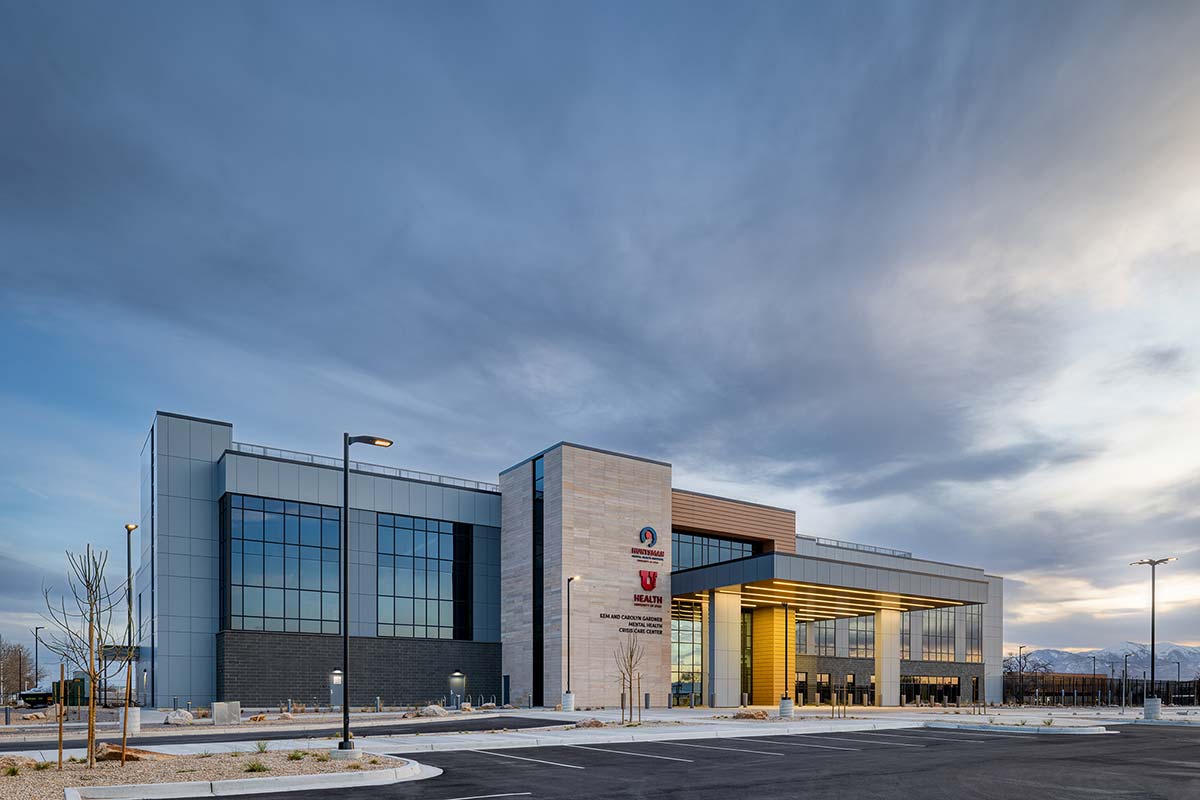
At Huntsman Mental Health Institute, the Crisis Care Center pairs a no-wrong-door model with what Kevin Curtis calls a “warm blanket” approach—creating a calmer, safer place for people in psychiatric crisis to pause, stabilize, and begin to heal.
July 14, 2026
When most adults experience a mental health crisis, their options are brutal: an overstretched emergency department, a jail booking desk, or nowhere at all. In Salt Lake County, a new “no wrong door” crisis care center is replacing those choices with a space that feels less like a holding pen and more like being wrapped in a warm blanket.
The Kem and Carolyn Gardner Mental Health Crisis Care Center is a 24/7 walk-in facility operated by Huntsman Mental Health Institute, the behavioral health arm of University of Utah Health.
Located in South Salt Lake, the Crisis Care Center offers immediate psychiatric evaluation and stabilization for adults 18 and older, without requiring an emergency department visit, an appointment, or the ability to pay.
As part of Huntsman’s broader mission to expand access to mental health care across Utah and beyond, the center serves as a single, reliable entry point where people in crisis are treated with the same level of seriousness and coordination typically reserved for physical health emergencies.
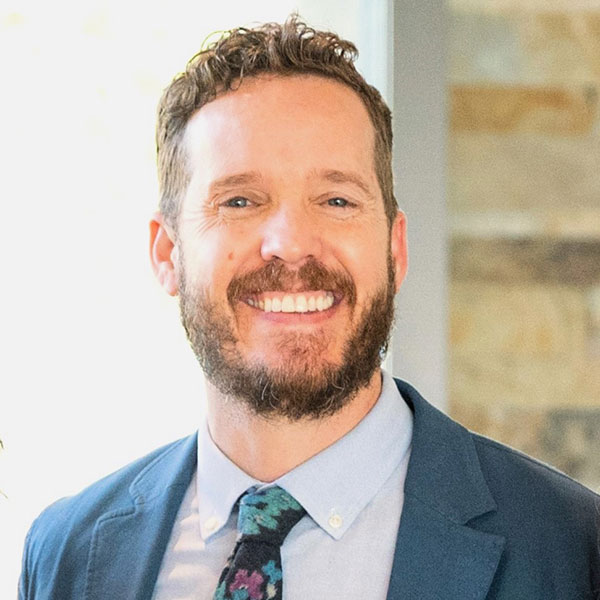
Kevin Curtis, Director of Hospital Crisis Service at Huntsman Mental Health Institute
The Problem We Keep Sending People Into
In Utah, the pathway into crisis care has long looked like the rest of the country—emergency departments built for heart attacks and car wrecks or jail booking areas even when no crime has been committed. What is really needed is treatment.
But the problem doesn’t affect only people who enter the system through first responders. When someone recognizes they are in crisis, or when a family member or friend sees the warning signs, the options can be just as limited at best or, at worst, a long wait for outpatient help or trying to hold on alone.
The stakes in Utah are especially high. Per the latest state rankings, Utah has the seventh-highest suicide rate in the nation, at 20.9 deaths per 100,000 people, and demand for crisis services has been climbing for years.
“One of the most profound challenges in the mental health epidemic is crisis care.”
Huntsman’s own community reporting has documented rising calls for intervention and a persistent shortage of the kinds of settings that can safely and appropriately receive people in psychiatric crisis. That leaves too many people waiting in places that were never designed for what they are experiencing—or avoiding care altogether until the situation becomes even more acute.
Kevin Curtis, Director of Hospital Crisis Service at Huntsman Mental Health Institute, calls crisis care “one of the most profound challenges with the mental health epidemic.”
“It’s one thing if someone is in need of mental health care,” he says. “But how should they be treated if they’re undergoing a mental health emergency?”
Curtis came to this work as a licensed clinical social worker who almost became a dentist. He jokes that he survived his dental prerequisites by taking psychology classes on the side, but those classes eventually pulled him into a master’s in social work and a career spent sitting with people in crisis. He also describes himself as “a big Mr. Rogers guy,” raised on the idea that everyone is your neighbor. That simple idea now shapes how he thinks about designing systems that actually receive people instead of processing them.
Over time, he came to see a fundamental mismatch between what people needed and what the system was built to deliver. “Our system has been missing, in spite of a lot of innovations, an in-person mental health crisis environment,” he says. The Crisis Care Center was built to be that environment: a place where adults can arrive with law enforcement, EMS, family, or entirely on their own, and get the care they need.
You might be thinking that this sounds a lot like an EmPATH unit. In fact, the Crisis Care Center functions quite differently, as the design and operations quickly make clear—but first, let’s talk about how it feels.
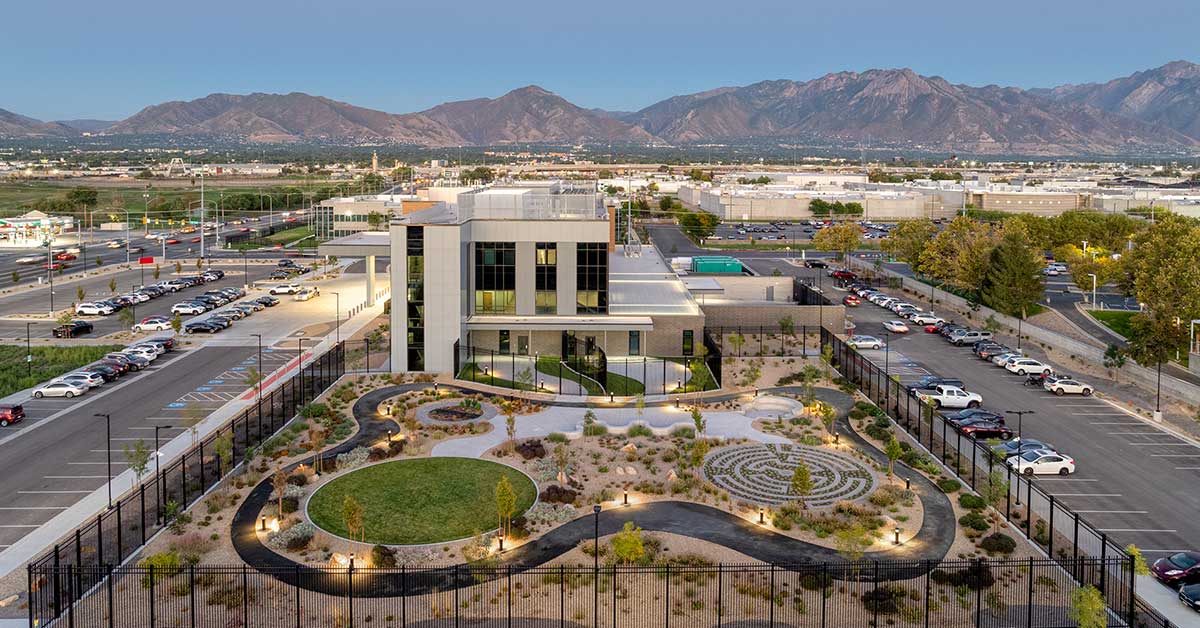
Huntsman Mental Health Institute Crisis Care Center Garden and West-Facing View (Image courtesy of FFKR Architects)
Warm Blanket Design and Experience
Crisis care spaces are often built around medical logic: bright lights, hard floors, constant noise. They are excellent at stabilizing someone who is bleeding or unconscious, but not when someone is suffering a mental health crisis.
Early on in its planning for the Crisis Care Center, Huntsman pulled together its patient and family advisory council, made up of former patients, current outpatients, and family members, who, Curtis said, could list a dozen reasons why the emergency department environment is totally inadequate if you’re terrified, suicidal, or disconnected from reality.
“If somebody walks in feeling like the world is hostile, the first thing they see shouldn’t reinforce that. It should say, ‘You’re safe here. You matter here.”
If the ED wasn’t the right model, what should crisis care feel like? “One person said, ‘It should feel like being wrapped in a warm blanket,’” Curtis recalls. “That was a lightning-bolt moment. We immediately recognized it as a metaphor we could use as a litmus test for every decision. What is the warm blanket design choice, the warm blanket process, the warm blanket product?”
What does a “warm blanket” look like in crisis care? For the team at Huntsman it meant warm color palettes, lots of natural light, and bringing nature into the building, and taking care out into nature. Just as important were the small, often invisible choices that shape how a space feels—the sounds, the surfaces, the way it meets you at three in the morning.
Their attention to small, human details extended to first responders bringing patients in. When the team asked law enforcement and EMS what they needed from the center, Curtis remembers hearing about clear criteria you’d expect such as quick handoffs, but they also asked for “a bathroom that we can use.”
It is a small detail, but a telling one. The center was built not only for people in crisis, but around the everyday realities of the people bringing them in.
Huntsman took that same logic further in everyday design decisions. “Most hospital environments are driven almost exclusively by regulatory concerns and compliance standards,” he explains. “Those conversations often get flattened to, ‘We’re just going to make the most conservative choice possible every time.’”
Flooring is one of his examples. “Hard surfaces are loud and unforgiving, and that doesn’t feel like a warm blanket,” he says. Huntsman’s team pushed instead for a hybrid material that lives between carpet and hard surface. It is soft and quiet underfoot, but still cleanable to 99 percent of the infection-control standard.
Safety is never an afterthought, but the Crisis Care Center still managed to follow the warm blanket approach to handling risk. Rather than designing every room for the rare worst-case scenario, Curtis talks about building a toolbox of connected tools. “Not everything is a nail, so don’t make your only option a hammer.”
To that end, a small number of rooms have traditional hard flooring to maintain infection control for patients with certain communicable diseases, but the 95 percent who don’t need the hard surface get the warmer experience.
It’s a subtle shift from designing for abstract regulations to designing for actual people but it adds up. “If somebody walks in feeling like the world is hostile,” Curtis says, “the first thing they see shouldn’t reinforce that. It should say, ‘You’re safe here. You matter here.’”
Continuum Under One Roof
What sets the Kem and Carolyn Gardner Mental Health Crisis Care Center apart is that it was built as a continuum instead of a single stop. Curtis describes it as “more of a system than a program,” designed to meet people where they are in a crisis and then keep them moving toward the right level of care.
At the front end is the receiving and stabilization service, where adults can walk in on their own, arrive with family or friends, or be brought in by law enforcement or EMS. There, patients are assessed and supported in a 30-chair receiving center with up to 23 hours of treatment and observation. For some, that short stay and a clear plan are enough to interrupt the crisis. For others, the team can step them into a higher level of care without handing them off to a different building or a different system.
That next step is a 24-bed inpatient acute care unit, which runs just under full capacity as people stabilize and move on. Between the front door and those beds is a floor of transitional outpatient and recovery-focused services that may be the center’s most important idea.
“The crisis stabilization function on the first floor is our reason for being,” Curtis explains. “The inpatient beds and outpatient services are our capacitation channels.”
In practice, that means the center isn’t just a place to get through the night. It’s built to step people up when they need more help, step them down when they’re ready, and connect them to longer-term providers before the crisis has a chance to harden again.
Transitions are where things so often fall apart. People are often most at risk right after they come out of a crisis or inpatient environment. Many communities stop at a receiving center or short-term stabilization unit and then rely on outside partners to absorb the rest. Curtis says, “If we can own those transitions, we can make them safer.”
Huntsman chose a different route. “We felt our system would be most functional if we built enough capacity inside the building to manage those levers ourselves,” he explains, “so we’re less reliant on the goodwill of others.”
“People are often most at risk right after they come out of a crisis or inpatient environment. If we can own those transitions, we can make them safer.”
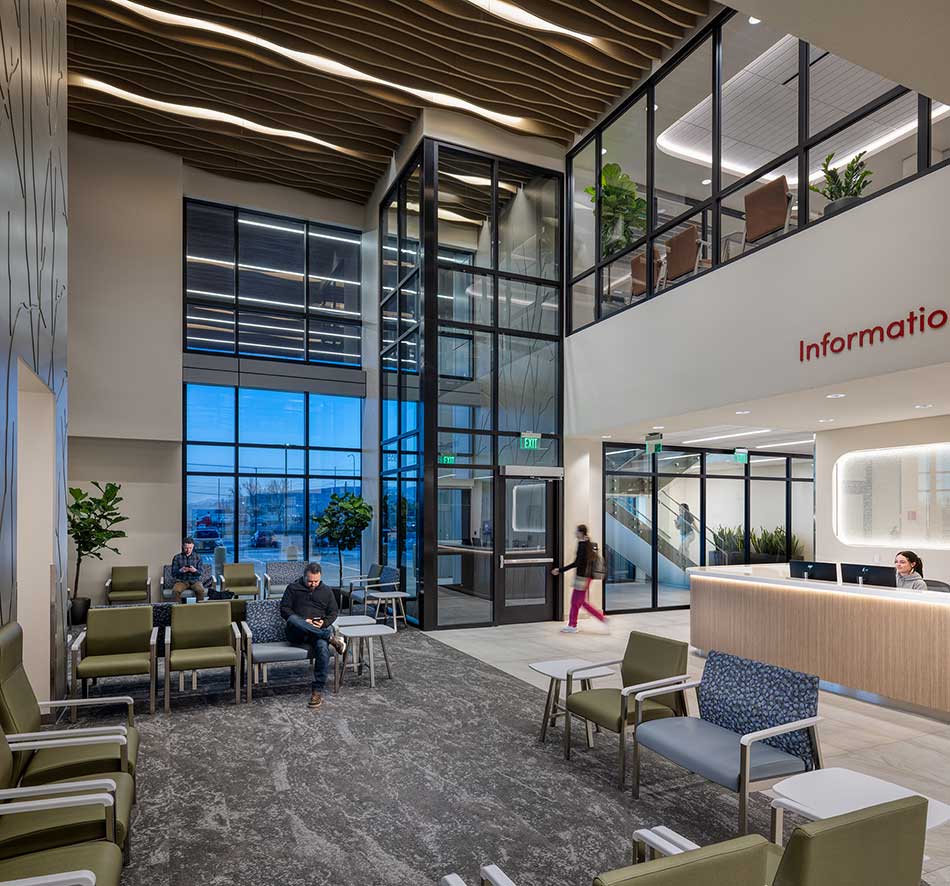
Huntsman Mental Health Institute Crisis Care Center Lobby (Image courtesy of FFKR Architects/Richer Images)
That same thinking shaped the financial model. If the center was truly going to function as a front door for anyone in crisis, it needed a payment system broad enough to support that promise. That is no small thing in behavioral health, where funding is often split into separate lanes.
“In most communities, mental health services actually bifurcate into more Medicaid-funded community services versus commercially funded,” Curtis says. “And each of those systems has its problems.”
The challenge was to build, in his words, “a broad enough gate” that people who were commercially insured, covered by Medicaid, or not insured at all could still come through the same front door and receive the same stabilizing care. The first piece of that challenge was Medicaid.
Huntsman worked with stakeholders in the Medicaid office and the Utah legislature to define a billing code and a reimbursement rate for this kind of crisis service. While the new building was still under construction, the team piloted the model at another site, billing Medicaid and collecting quality and outcome data along the way. That gave them something concrete to bring back to commercial insurers.
“A person can walk in for crisis stabilization, get care, and walk away without a bill becoming one more stressor they have to carry home.”
Curtis said many people assumed commercial plans would be the hardest part, but he found the conversation surprisingly straightforward. “Would you like this to be available to your people?” he recalls asking. The argument was simple—this is a service patients prefer, it is more effective at relieving symptoms, and it can reduce the need for costly inpatient care.
“Almost every insurance company that we contract with commercially came on board without any sort of fuss,” he says.
That left the final category—people with no funding source at all. For them, Huntsman again turned to the Utah legislature and made the case for recurring public support.
Curtis said lawmakers responded in part because the center provides first responders with better tools and offers a more humane alternative to emergency departments and jails. The result was a recurring annual allocation that helps backstop care for uninsured patients.
All that complexity lets the Crisis Care Center keep its promise. A person can walk in for crisis stabilization, receive care, and leave without a bill becoming one more stressor to carry home. “It just really makes it easy to tell the story of just come and we’ll be here to help support you,” Curtis says.
Treating the Whole Crisis, Not Just the Symptoms
Most crisis settings stop at stabilizing symptoms. The Crisis Care Center is built around asking what pushed this person over the edge today and whether any of that can be changed.
Curtis has seen over and over that answer can be complex. “Just as often as biology or genetics or the need for medication, an unmet legal need might be the thing driving the crisis,” he says.
Imagine someone struggling with depression, missing work, falling behind on rent, and then seeing an eviction notice. Curtis says that under different circumstances, that person might act proactively, but when already struggling, that can push them into crisis.
That is where the center’s on-site law clinic comes in. Staffed by faculty attorneys and supervised law students, it gives people in crisis access to real legal advice without leaving the building.
“What sets the Crisis Care Center apart is that it was built as a continuum instead of a single stop. It’s more of a system than a program, designed to keep people moving toward the right level of care.”
Instead of focusing only on mood or psychosis scores, the team can ask, what’s going on that’s contributing to this? Is there a stressor we can do something about?
“Sometimes just saying, ‘Would it help if we could get you in to see our legal clinic tomorrow?’ is enough to give people hope that the stressor is real, it matters to us, and there may be solutions they just can’t see right now,” Curtis explains.
The clinic can’t fix every legal problem, but it can validate the crisis, outline options, and help someone call a community agency right there and then to schedule an intake to contest the eviction. “That amount of help can be enough for someone to say, ‘I’m still depressed, but I no longer want to be dead,’” he says.
Dental and medical needs often show up the same way. “The number of times we’ve had someone say, ‘Oh, I’ve had this tooth abscess, and I can’t find any way to get help with that,’ is astounding,” Curtis says.
For someone already in pain and overwhelmed, that untreated abscess is not separate from their mental health crisis; it’s part of it. At the Crisis Care Center, dentists and dental students can often address those urgent needs immediately or at least triage them into care within the university dental system.
On the medical side, the pattern is similar. “You might have someone who’s anxious and having mood instability, and you find out they’ve had unregulated blood sugar and high blood pressure for two years,” he notes.
It is hard to feel less anxious when your heart rate and blood pressure are always through the roof. The on-site medical clinic can’t cure that with one dose in the stabilization unit, but it can start medications, monitor progress over a few months, and make sure the person is connected to a long-term medical provider by the time they graduate from the program.
From the outside, these law, dental, and medical visits might look like extras. Inside the building, they are treated as core crisis work. “If you’re only asking, what’s the symptom and how bad is it, you could miss the thing that tipped them into crisis,” Curtis says.
When the team addresses those resolvable drivers alongside psychiatric treatment, the shape of the crisis changes. People still leave with diagnoses, prescriptions, and therapy referrals, but they also leave with an eviction appeal in motion, a tooth that no longer throbs, or a plan to bring their blood pressure down.
In a system where so much of the burden falls on the person in crisis to put the pieces together, the Crisis Care Center’s whole-person approach is a quiet statement of belief: you shouldn’t have to untangle all of that alone, especially not on the worst day of your life.
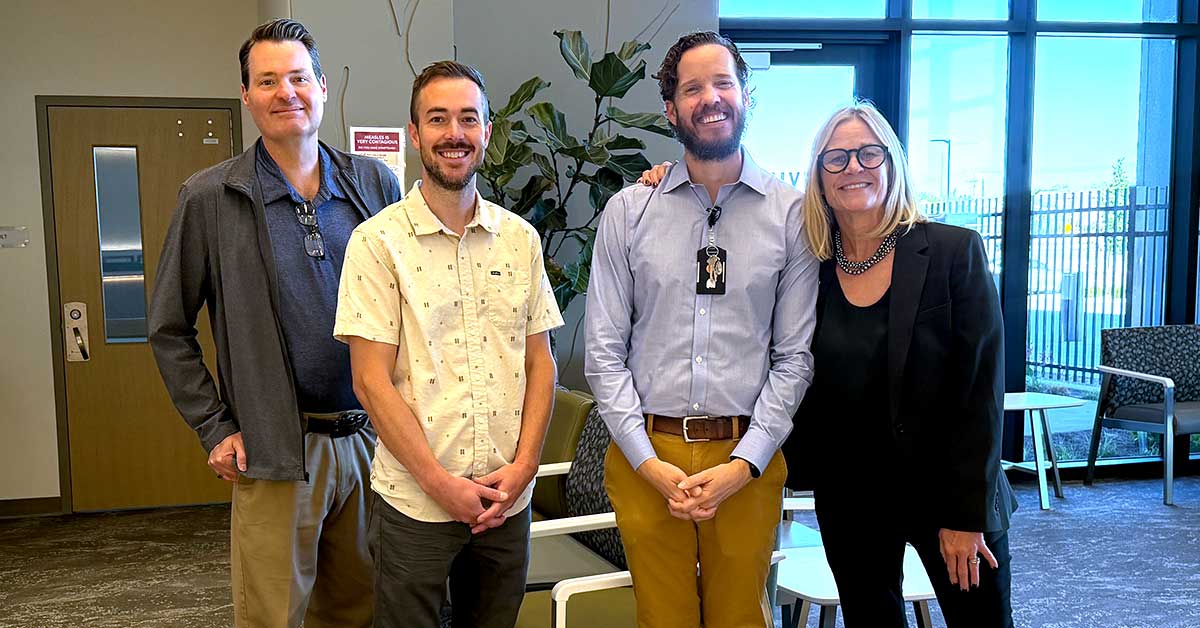
Facility Tour, L–R: Wes Lovell (The Lovell Company); Jake Fitzgerald (The Lovell Company); Kevin Curtis, Director of Hospital Crisis Service at Huntsman Mental Health Institute; and Kristin Kahle, President of Whitehall Manufacturing
A Better Answer to Crisis
For all its operational complexity, the idea behind the Crisis Care Center is surprisingly simple—people in psychiatric crisis deserve a better answer. Not a better version of the emergency department. Not a gentler path into jail. Something else entirely.
In Utah, that “something else” is beginning to take shape in a building that asks different questions. Not “Are you sick enough to be here?” But ”What happened, what do you need, and how do we help you move forward?”
That shift may be what feels most ambitious about the center. It treats crisis care not as a last resort, but as an essential part of a functioning health system. It assumes that people deserve to be received before they are sorted, and that the right environment, the right handoff, or the right connection at the right moment can change what happens next.
Curtis has described the work as an opportunity to “unmake and remake systems” so they finally do what they were intended to do for the people they serve. That may be the larger lesson here.
Innovation in behavioral health does not always arrive as a new technology or a sweeping theory. Sometimes it looks like a front door that stays open, a softer floor underfoot, an eviction notice taken seriously, and a place that refuses to treat the worst day of someone’s life as an inconvenience.